
Selling a home is a major financial decision, and even small mistakes can affect your final selling price, timeline, and overall experience. Whether you're preparing to sell your first property or have sold several homes before, understanding common Southern Maryland home selling mistakes can help you make better decisions.
The real estate market across St. Mary's, Calvert, and Charles counties includes a wide variety of properties, from established residential neighborhoods and townhomes to rural properties and waterfront homes. That variety makes it important to develop a selling strategy based on your property's condition, location, and current competition.
The good news is that many common selling mistakes can be avoided with thoughtful preparation and reliable local information.
Here are eight mistakes Southern Maryland homeowners should watch for and what to do instead.
1. Overpricing Your Home in the Southern Maryland Market

One of the most common mistakes homeowners make is setting an asking price based on personal expectations rather than current market evidence.
It's understandable to consider how much you've invested in your home, what neigh
boring properties are listed for, or what an online valuation tool suggests. However, those numbers don't always reflect what buyers may be willing to pay.
An active listing shows what another seller is asking. A recently closed sale provides evidence of what a buyer actually paid under a particular set of circumstances.
Even within Southern Maryland, properties can differ significantly in size, condition, acreage, improvements, and location. These differences matter when determining a competitive asking price.
How to avoid this mistake
Start with a comparative market analysis that considers:
- Recently sold properties with similar characteristics.
- Active listings competing for buyer attention.
- Property condition and significant improvements.
- Lot size, location, and distinctive features.
- Current inventory and market activity.
The Southern Maryland Association of REALTORS housing statistics provides regional housing information that can help put market conditions into perspective.
However, broad market trends should not replace an evaluation of your specific property.
Overpricing may discourage qualified buyers or lead to price reductions later. A well-supported asking price gives your home a more realistic starting position without promising a particular outcome.
2. Spending Too Much On Repairs and Renovations
Many sellers assume they need to renovate extensively before listing their property.
While improvements can make a home more appealing, not every renovation produces enough additional value to justify its cost.
For example, replacing functional kitchen cabinets or installing expensive finishes may not be the best use of your preparation budget if the home has unresolved maintenance issues.
The condition of the property and the expectations of buyers considering similar homes should guide your decisions.
How to avoid this mistake
Separate potential improvements into three categories:
- Necessary repairs: Address known leaks, damaged components, safety concerns, and maintenance problems.
- Presentation improvements: Consider cleaning, minor painting, landscaping, and cosmetic touch-ups.
- Optional renovations: Evaluate major upgrades before spending money.
Some Southern Maryland properties have wells, septic systems, decks, crawl spaces, or waterfront-related features that may require additional attention.
If these features are present, reviewing maintenance records and known conditions before listing can help you prepare for buyer questions.
Not every issue requires a repair before selling. Depending on the circumstances, you may decide to address a concern through pricing or negotiated contract terms.
The goal is to improve the property's marketability without spending unnecessarily.
3. Neglecting Home Presentation and Marketing
Most buyers begin evaluating properties through online listings, making your home's presentation an important part of the selling process.
Poor lighting, cluttered rooms, unclear photographs, and incomplete descriptions can make it difficult for buyers to understand a property's features.
Even a well-maintained home may be overlooked when its marketing materials do not present it clearly.
How to avoid this mistake
Prepare your home before photography and marketing begin.
Focus on:
- Thorough cleaning and decluttering.
- Removing unnecessary personal items.
- Improving lighting and visibility.
- Completing small cosmetic repairs.
- Preparing landscaping and exterior spaces.
- Using clear, accurate listing photographs.
Property descriptions should highlight useful, verifiable features such as finished living areas, storage, outdoor spaces, garages, and recent improvements.
For properties with waterfront features, acreage, or accessory structures, accuracy is especially important. Marketing should distinguish between features that are part of the property and amenities located nearby.
Professional presentation is not about making a home appear different from reality. It is about helping prospective buyers understand the property's actual condition, layout, and features.
4. Making Your Home Difficult for Buyers to View
Keeping a property ready for showings can be challenging, particularly when you're still living there.
Work schedules, pets, household activities, and moving preparations can make it tempting to restrict appointments.
However, consistently declining showing requests or offering very limited availability may prevent interested buyers from seeing the property.
Some buyers may also be coordinating home searches with travel, work commitments, or relocation schedules.
How to avoid this mistake
- Develop a reasonable showing plan before the listing becomes active.
- Consider: setting practical advance-notice requirements, maintaining a simple daily cleaning routine, and arranging for pets during appointments.
If you cannot accommodate a requested showing, offer another reasonable opportunity when possible.
It is also helpful to review buyer feedback with your real estate agent.
One buyer's opinion may reflect personal preferences. Repeated concerns about the same issue, however, may indicate something worth investigating.
The objective is to balance your daily needs with reasonable opportunities for prospective buyers to evaluate the home.
5. Overlooking Maryland Seller Disclosure Requirements

Understanding seller disclosure obligations is an important part of preparing a home for sale.
Maryland has specific requirements concerning residential property disclosure and disclaimer statements.
Under Maryland Real Property § 10-702, sellers of covered residential properties generally must provide the applicable disclosure or disclaimer statement.
The law also addresses known latent defects. These are generally material defects that would not be reasonably apparent through a careful visual inspection and that pose a direct threat to health or safety.
Choosing a disclaimer does not automatically remove the obligation to disclose known latent defects.
How to avoid this mistake
Review the current Maryland residential property disclosure/disclaimer form early in the selling process.
Gather available records concerning known property conditions, including:
- Previous water intrusion or moisture problems.
- Roof repairs or recurring leaks.
- Structural concerns.
- Plumbing, electrical, or mechanical issues.
- Well and septic systems, when applicable.
- Other known defects that may require disclosure.
Keep in mind that selling a property as-is does not necessarily eliminate applicable disclosure duties.
Some transactions are exempt from particular requirements, and the legal obligations depend on the circumstances.
If you are uncertain about a disclosure, an exemption, or a known property condition, consult a qualified Maryland real estate attorney.
Accurate disclosures help buyers evaluate the property and can reduce misunderstandings during the transaction.
6. Accepting an Offer Based Only on the Purchase Price
A high purchase offer can be appealing, but the offered price is only one part of a real estate contract.
Two offers with different prices may also have different financing arrangements, contingencies, concessions, and settlement schedules.
For example, one buyer might offer more money while requesting substantial closing cost assistance or additional contract conditions.
Another buyer might offer slightly less with terms that better align with your priorities.
Neither offer is automatically superior without reviewing the complete agreement.
How to avoid this mistake
Compare offers using several factors:
- Purchase price.
- Requested seller concessions.
- Financing arrangements and supporting documentation.
- Earnest money deposit.
- Inspection and appraisal contingencies.
- Proposed settlement date.
- Other contractual conditions.
A buyer's financing type alone does not guarantee approval or determine whether the transaction will close.
Consider how each offer affects your estimated proceeds, contractual obligations, timing, and potential uncertainty.
Your real estate agent can help you understand the differences so you can select the offer that best meets your objectives.
7. Underestimating Home Selling Expenses

One of the most important financial distinctions in a real estate
transaction is the difference between the selling price and the seller's net proceeds.
Your accepted purchase price is not necessarily the amount you will receive at settlement.
Expenses and deductions may include:
- Outstanding mortgage payoff.
- Other liens or required payoffs.
- Negotiated real estate brokerage compensation.
- Applicable transfer and recordation charges.
- Settlement-related expenses.
- Property tax or other prorations.
- Negotiated seller concessions or repair credits.
The actual amounts depend on your property, contract, and transaction circumstances.
How to avoid this mistake
Request an estimated seller net sheet before committing to a pricing strategy or accepting an offer.
A net sheet typically begins with an estimated selling price and subtracts anticipated payoffs and transaction expenses.
This can help you understand how different offers or concessions may affect the money remaining after settlement.
Remember that an estimated net sheet is a planning tool, not a guarantee. Final figures may change as the transaction progresses.
If you are planning to purchase another home, understanding your estimated proceeds is particularly useful when considering your next budget and moving arrangements.
For additional preparation guidance, explore our Southern Maryland seller resources
8. Waiting Too Long to Plan Your Home Sale
A successful home sale requires coordination among several stages, and each can affect the overall timeline.
Preparing the property, selecting a listing price, arranging photography, scheduling showings, negotiating an offer, completing inspections, and reaching settlement all take time.
Waiting until you have an immediate need to move can create unnecessary scheduling pressure.
How to avoid this mistake
Begin planning before your preferred moving date whenever possible.
A practical selling plan should account for:
- Reviewing the property's condition and necessary preparation.
- Evaluating pricing and marketing strategies.
- Completing photography and listing arrangements.
- Allowing time for showings and negotiations.
- Addressing contractual inspections and contingencies.
- Coordinating settlement, possession, and moving logistics.
Homeowners relocating for work or preparing for a military PCS move near NAS Patuxent River may need to coordinate additional travel and moving arrangements.
If you are buying another property, consider how the timing of both transactions could affect your finances and possession plans.
No specific closing timeline is guaranteed. Building flexibility into your schedule can help you respond to unexpected delays.
A Better Approach to Selling Your Southern Maryland Home
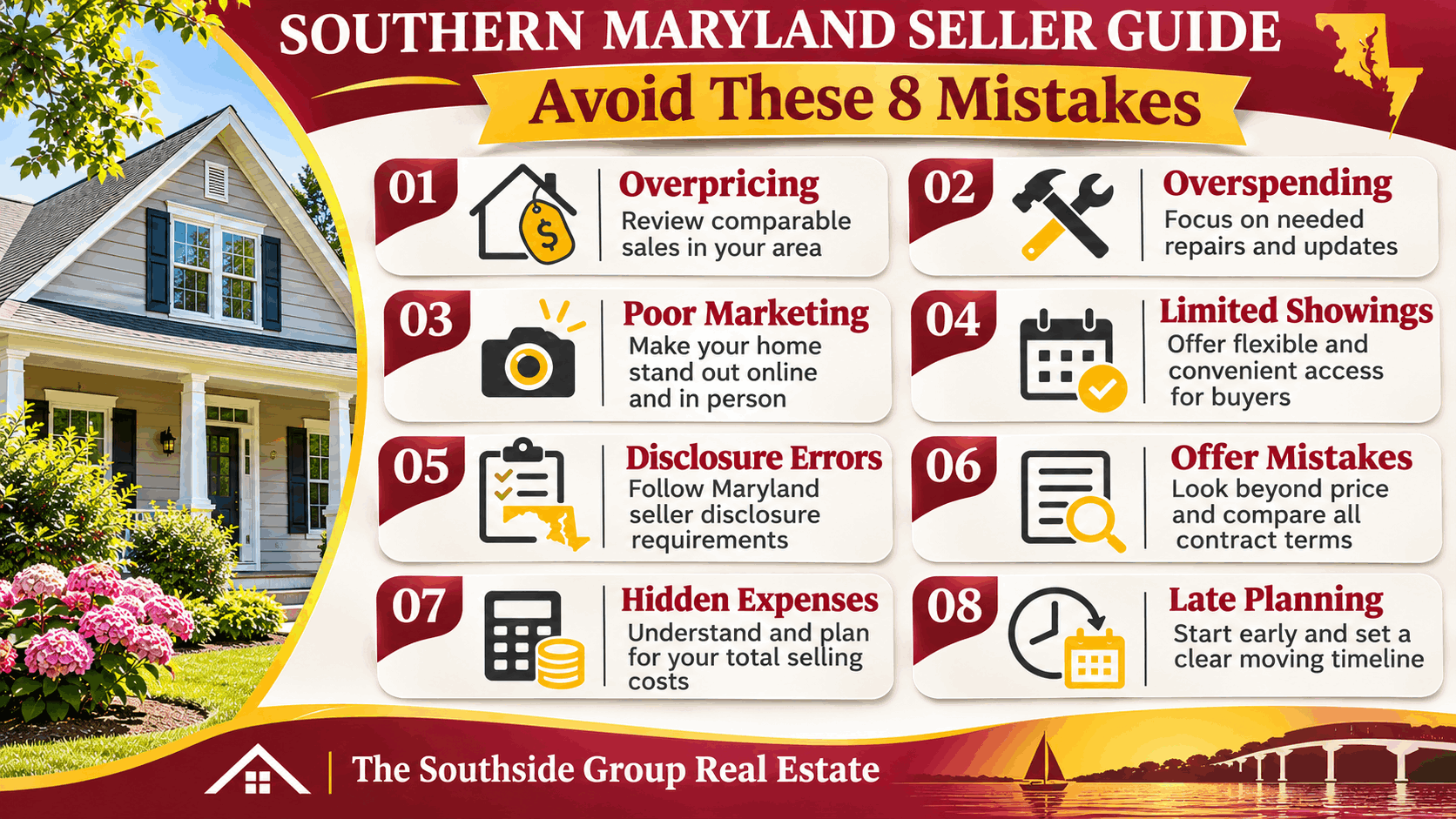
Avoiding these mistakes begins with understanding your property and preparing a realistic plan.
Before listing, take time to evaluate your home's market position, determine which improvements are worthwhile, understand your legal obligations, and estimate your potential proceeds.
The right approach should reflect your property, financial priorities, and preferred moving timeline rather than a one-size-fits-all formula.
With accurate information and thoughtful preparation, Southern Maryland homeowners can approach the selling process with greater clarity and confidence.
Frequently Asked Questions
What is the biggest mistake homeowners make when selling in Southern Maryland?
Overpricing without reviewing current comparable sales is one of the most consequential mistakes. A competitive asking price should reflect the property's condition, location, recent sales, and available competing listings rather than relying solely on an online estimate.
How do I determine the right asking price for my Southern Maryland home?
Start with a comparative market analysis that examines recently sold properties, active competition, and relevant differences in property features. A local real estate professional can help interpret that information and recommend a pricing strategy.
Should I make repairs before listing my house?
Focus first on known maintenance problems and repairs that may affect buyer interest or inspections. Major renovations should be evaluated individually because their costs may not be fully recovered through the selling price.
What must Maryland homeowners disclose when selling a property?
For covered residential transactions, Maryland generally requires an applicable property disclosure or disclaimer statement. Sellers must also disclose known latent defects as required by law. The specific requirements and exemptions depend on the transaction. Consult a Maryland real estate attorney when necessary.
How can I estimate my proceeds from selling a home?
Subtract your mortgage payoff, other liens, applicable settlement expenses, negotiated brokerage compensation, and any seller concessions from your estimated selling price. A seller net sheet can help organize these figures before you accept an offer.
Thinking About Selling Your Southern Maryland Home?
Every property is different, and a successful selling plan should reflect your home's condition, local competition, financial priorities, and preferred moving timeline.
The Southside Group Real Estate helps homeowners throughout Southern Maryland prepare for important selling decisions.
Before choosing your asking price or spending money on improvements, consider requesting a home valuation to better understand your property's potential market position.
FROM OUR BLOG


Where to Order Thanksgiving Dinner in Southern Maryland
Thanksgiving is almost here, and if you'd rather spend the holiday enjoying good food and good company than cooking all day, you're not alone. Finding Thanksgiving dinner in Southern Maryland doesn't have to mean preparing everything yourself. Whether you're hosting a gathering in Leonardtown, celeb

Southern Maryland Housing Market Update | November 18, 2026
What is happening in the Southern Maryland real estate market this week? The latest Southern Maryland housing market update shows that buyers are still making moves, homes are going under contract, and price reductions may be creating opportunities for those searching for their next home. Across St.

Southern Maryland Home Warranty: What Is It and Is It Worth It?
Buying a home in Southern Maryland is exciting, but homeownership also comes with responsibilities. One of the biggest concerns for buyers is what happens when an expensive appliance or major home system breaks down shortly after moving in. A Southern Maryland home warranty may help with certain rep